Queue, Carve, Repeat: What Britain’s Carvery Staff Wish You Knew
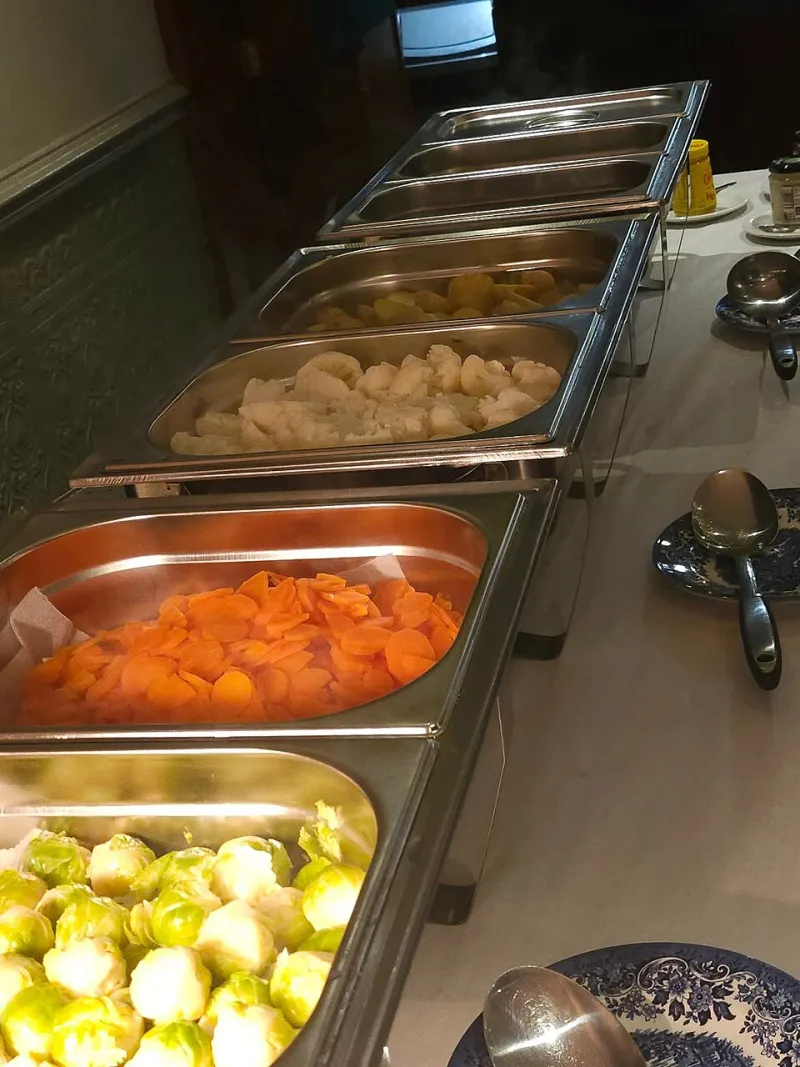
Photo: Wildhomme, CC BY 4.0, via Wikimedia Commons
Sunday lunch is a national sport, and the carvery is its most democratic arena. You queue with strangers, clutch a plate that is somehow always too hot, and make split-second decisions about whether you can fit one more roast potato without the whole thing collapsing. Behind the counter, though, a different drama is unfolding. The slicer has seen things. The gravy attendant has heard things. The Yorkshire pudding guardian has developed the patience of a saint and the eyes of a hawk.
The queue is a living, breathing thing
Ask anyone who works a carvery and they will tell you the same thing: the queue has a personality. At 12.15pm it is polite and hopeful. By 1pm it has become a family reunion, a toddler obstacle course and a low-level negotiation about who saved whose table. By 1.45pm it is pure hunger with a side of passive aggression.
'You can tell a lot about a family from how they queue,' says Elaine, who has worked the carvery at a hotel just outside Leeds for eleven years. 'There is always one dad who walks ahead to scout the meat, then reports back like he has been on a reconnaissance mission. There is always one nan who says she is not having much, then asks for three slices of beef and a bit of crackling.'
The unofficial rule is simple: keep moving, keep the tongs moving, and never block the Yorkshire pudding tray while you decide whether you want stuffing. The stuffing is not going anywhere. The queue, however, has a long memory.
Portion diplomacy and the Yorkshire pud standoff
Carvery staff are not just servers. They are diplomats. The slicer must judge whether 'a little bit' means two thin slices or a slab the size of a paperback. They must handle the customer who asks for 'the end bit' as if it is a human right. They must remain calm when someone says, 'Just a bit of gravy' and then watches like a disappointed headteacher as you pour.
'You get a sixth sense for it,' says Marcus, who has been carving at a pub carvery in Bristol for six years. 'Some people want the theatre. They want you to hold up the joint and say, 'This one's been in since seven.' Others want you to get on with it so they can get to the roast potatoes. I respect both.'
Then there is the Yorkshire pudding question. In 2026, the Yorkshire pudding is still the most politically sensitive item on the plate. Some carveries hand them out. Some let you help yourself. Some operate a one-per-person policy that is enforced with a quiet but unmistakable look. The staff know the rules. The customers pretend not to. It is a delicate ecosystem.
Gravy is not a soup course
The gravy station is where the carvery reveals its true self. There are the drizzlers, the moaters, the people who ask for gravy 'right over the lot' and then wonder why their plate looks like a flooded battlefield. There is also the person who says, 'No gravy for me,' and then hovers with a jug as if they might change their mind.
'My favourite is the couple who both say they don't want gravy, then one of them whispers, 'Just a little bit of mine on the side,'' says Priya, who runs the carvery at a garden centre café in Surrey. 'We call it the secret gravy shuffle. It happens every single Sunday.'
The staff rule is not about judgement. It is about logistics. Gravy on the Yorkshire pudding makes it soggy. Gravy on the stuffing is a bold move. Gravy on the plate before the meat is a rookie error. You learn to pour with precision, and you learn to keep a cloth nearby.
The last roast potato is a tragedy in miniature
The carvery counter is a place of quiet heartbreak and quiet joy. The heartbreak is the last roast potato. Someone has to take it. Someone has to watch the tray go from full to empty while a queue of people behind them silently calculate their chances. The joy is the first Yorkshire pudding of the day, still tall and crisp, or the moment a child discovers that cauliflower cheese counts as a vegetable portion.
'You see families at their best and worst,' says Elaine. 'At their best, they are helping each other carry plates and laughing about how much they have piled on. At their worst, someone is asking why the parsnips have run out as if I have personally hidden them.'
The quiet code behind the counter
By the time the last queue has shuffled past and the lights are being switched off, the carvery team has performed a small miracle. They have fed hundreds of people, kept the gravy warm, defended the Yorkshire puddings and smiled through the bit where someone asked for 'just a tiny bit more' for the fourth time.
So next Sunday, when you stand there with your plate and your choices, remember the people behind the counter. They are not just slicing meat. They are keeping the whole ritual together, one polite queue, one perfect roast potato and one carefully poured jug of gravy at a time. And if you see the last Yorkshire pudding sitting there, alone, know that someone has already made a difficult decision. Be kind. Take the parsnip.